
WindEnergy Hamburg 2026: Key Takeaways from the Global Wind Industry
05 Oct, 20265 mins
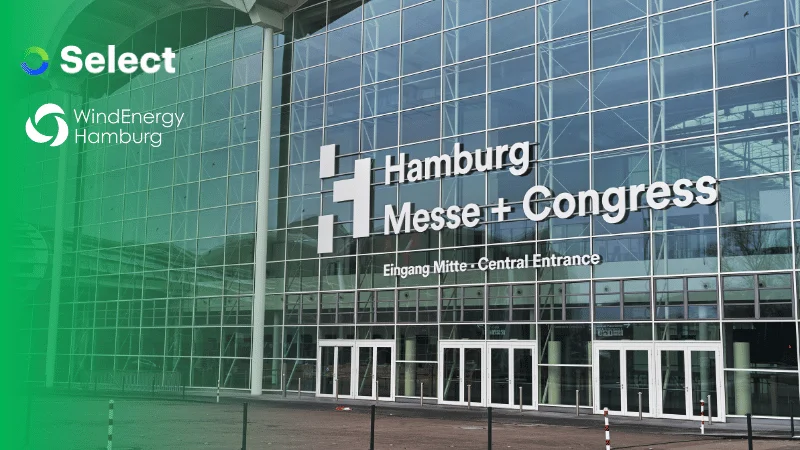
WindEnergy Hamburg 2026 brought together more than 43,000 attendees and 1,600 exhibitors from across the global wind industry, covering both onshore and offshore wind. With companies from across the value chain represented, the event provided an opportunity to see the latest technologies, meet businesses operating in different markets and hear first-hand about some of the challenges facing the industry.
Our team attended this year's event and came away with several interesting observations around the changing global market, turbine technology, clean energy and energy security, energy storage and the workforce.
These conversations also reflect wider changes taking place across the wind industry. According to the Global Wind Energy Council (GWEC), a record 165 GW of new wind capacity was installed globally in 2025. Asia-Pacific accounted for 131.8 GW of new capacity, while Europe added 19.1 GW. The figures highlight the increasingly global nature of the wind market and the scale of activity developing across different regions.
Here are some of the key takeaways from WindEnergy Hamburg 2026.
1. Strong Presence from Asian Companies
The event highlighted the strong presence of Asian companies across the wind industry, demonstrating increasing competitiveness and market activity.
This is not surprising considering GWEC’s 2026 Global Wind Report shows that Asia-Pacific accounted for around 80% of new global wind capacity installed in 2025, with China and India driving much of that growth. Europe remains an important market, but the scale of development across Asia highlights how increasingly international the wind industry has become.
For companies operating across the wind sector, this growing international activity could create new opportunities while also increasing collaboration and competition between businesses from different markets.
The industry is no longer developing around a small number of established markets. Wind projects, suppliers, manufacturers and specialist service providers are increasingly operating across a global landscape.
2. The Next Generation of Onshore Wind Turbines
WindEnergy Hamburg also highlighted how quickly turbine technology continues to evolve, particularly across the European onshore market.
The focus is increasingly shifting beyond simply building larger turbines. Instead, manufacturers are looking at how to extract more value from each megawatt, particularly in lower-wind locations where maximising energy yield and project economics can be more challenging.
Three major OEMs unveiled new turbine platforms aimed at this challenge.
Vestas – V182-7.2 MW
Built on the EnVentus platform, Vestas' new V182-7.2 MW features a 182m rotor machine targets low-to-medium wind sites. The company says it can increase annual energy production by up to 6% compared with the V172-7.2 MW, while improving capacity factor by up to 2% and capture prices by up to 3%, depending on site conditions.
Nordex – N193/7.X
Nordex has expanded its Delta4000 platform with a 193m rotor, 95m blades and 7.3MW installed capacity, targeting medium- and low-wind locations. Serial production is planned for 2029, with the machine initially available at up to 6.6MW to accommodate permitting and grid requirements.
Envision – EN175/8.0
Envision's new European Model T combines an 8MW rating with a 175m rotor and AI-enabled turbine controls. The OEM says the machine can deliver a 2–12% increase in energy yield, depending on site conditions.
What stands out is that the competition is shifting beyond headline MW ratings.
Rotor-to-rating optimisation, performance at lower wind speeds, grid-forming capability, noise reduction, platform standardisation and increasingly intelligent controls are becoming becoming important parts of the value proposition.
For developers, owners and investors, that means the turbine conversation is becoming less about "How big is it?" and more about "How much value can it create across the full project lifecycle?"
With several major manufacturers developing new platforms at the same time, it will be interesting to see how these technologies influence the European onshore market over the coming years.
3. The Push Towards Clean Energy and Greater Energy Security
The transition towards clean energy was one of the biggest topics discussed at the event, with energy security closely linked to the wider push to expand renewable generation.
For Europe in particular, increasing renewable energy capacity is not only about meeting climate goals. It also has implications for energy security, competitiveness and reducing reliance on imported fossil fuels.
Wind energy can play an important role in diversifying Europe's energy supply, but the transition will require continued investment across generation, grid infrastructure, storage and the wider energy system.
The discussions in Hamburg highlighted that building more renewable generation is only part of the challenge. The infrastructure and systems needed to connect, store and manage that energy will need to develop alongside it.
4. Energy Storage Is Becoming an Increasingly Important Part of the Conversation
Energy storage was a particularly prominent focus at this year's event.
WindEnergy Hamburg introduced a dedicated Energy Storage Area for 2026, reflecting the growing focus on how renewable electricity can be stored and managed as generation capacity increases.
As more wind power comes onto the grid, the challenge isn't simply generating electricity. The wider energy system also needs to be able to manage when that electricity is produced, where it is needed and how it can be stored or integrated into the grid.
This makes energy storage, grid infrastructure and intelligent energy management increasingly important parts of the wider renewable energy conversation.
5. A More Diverse Workforce
One of the positive observations from this year's event was the increased visibility of women across the exhibition, conference sessions and networking activities.
While there remains significant work to do to improve representation across the energy and wind sectors, it was encouraging to see a broader and more diverse mix of professionals participating in WindEnergy Hamburg. This reflects the industry's growing focus on attracting talent from a wider range of backgrounds and experiences.
As the renewable energy sector continues to expand globally, building a diverse workforce will be critical to supporting long-term growth, innovation and skills development. Creating opportunities for people from different backgrounds, disciplines and perspectives will help ensure the industry has the talent required to meet future demand.
Looking Ahead
WindEnergy Hamburg provided a useful snapshot of an industry that continues to develop while navigating some significant challenges.
The conversations around global market growth, turbine technology, clean energy, energy security, energy storage and the workforce all point towards a wind industry that is becoming increasingly interconnected.
For the workforce, these developments could also create changing requirements for specialist skills and experience as projects become more complex and markets continue to develop.
At Select, we work with clients and skilled professionals across both onshore and offshore wind, as well as the wider energy sector. Understanding how the industry is evolving helps us better understand the changing requirements of the projects and businesses we support.
Looking to strengthen your wind workforce or explore your next opportunity in the sector? Get in touch with our team.
Related Posts
Why Specialist Offshore Recruitment Matters
18 Jun, 2026